Transactional Analysis Therapy – Transactions
How one interacts with people verbally & non verbally and to understand the issues in communication
Note: Here Parent denotes an authority figure, Child denotes a submissive figure and Adult denotes an equal person to the other. From which ego state the transactions happen is perceived based on the tone, gesture, posture and eye contact and not just by the content.
Transaction Types:
When we interact with each other, there are three types of transactions:
- Parallel (Complementary)
- Crossed
- Hidden (Ulterior)
1. Parallel (Complementary)
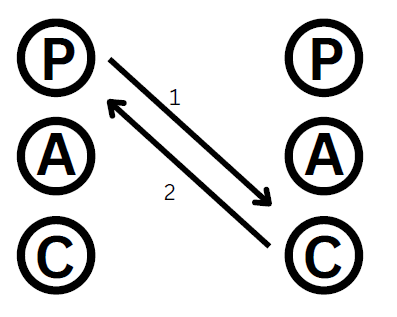
Parallel or complementary transactions are those where the individuals respond as expected. This means when I address someone’s Child ego state from my parent ego state, I expect them to respond from their Child.
In such cases – when the players ‘know’ which roles to play – the interaction can continue through numerous transactions, each person reacting as expected from their set ego state. The numbers are given in the brackets in the diagram.
Example:
Manager (1): You still haven’t given the report I asked for (in an Aggressive Tone)
Team Member (2): Sorry, I did not get the file from accounts department. Once you get me that, I will complete (in a submissive tone)
2. Crossed
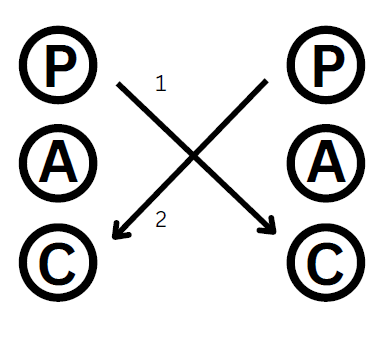
These are transactions in which the respondent comes from an ego state which is not the one ‘expected’ by the initiator. Because of this, crossed transactions tend to come to an end sooner than parallel transactions. The first example diagram below shows the interaction with the respondent in Parent ego state, whereas the second example diagram shows an Adult response to the same initial transaction.
Example 1:
Manager (1): You still haven’t given me the report I asked you for. You are always doing this. (in an aggressive tone.)
Team Member (2): I wasn’t given the data by accounts. (in a careless way)
Manager (1): Why didn’t you inform me of this earlier? (in an Aggressive tone)
Team Member (2): You were busy. I didn’t want to disturb you. (Casually telling)
Manager (1): Just because my door is shut, doesn’t mean you can’t come in (aggressive tone)
Example 2:
Manager (1): You still haven’t given me the report I asked you for. You are always doing this. (aggressive tone)
Team Member (2): Yes. I understand the problem and I would appreciate your help in getting the last information I need from the accounts department. (Neutral tone)
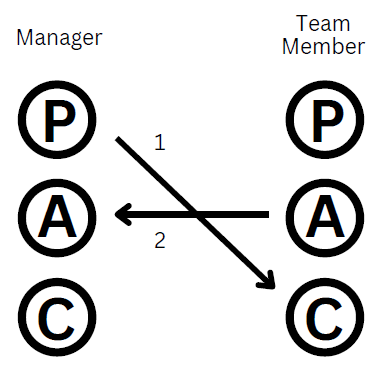
Just by reading the different responses from the team member in example 1 and example 2, we can actually feel the difference between the contrasting scenarios. In the example 1, both manager and team member are behaving from their Parent ego state. In the example 2, team member responds differently that may lead to solution to the problem.
3. Hidden (Ulterior)
Hidden transactions are the ones which appear to be straightforward communications but which actually contain an unspoken message that carries with it a hidden agenda.
These transactions mostly lead to games (drama triangle) being played. They can often be seen in personal relationships and avoiding them can require some discipline from the individuals involved.
With ulterior transactions there is a hidden hook which pulls us into a drama triangle if we are not aware of what is happening.
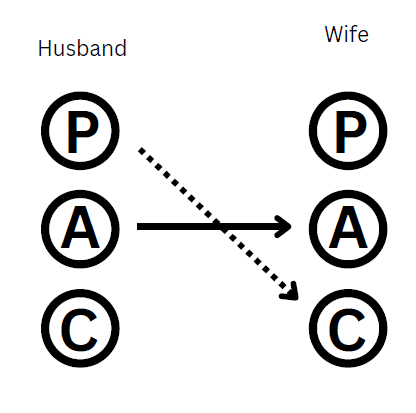
In the following example we shall consider a husband and wife who have been together for a number of years. For some time it has bothered the husband that his wife can sometimes be forgetful or misplace things. Having used the car the previous night she left the keys on the kitchen table rather than return them to the shelf by the front door where they ‘belong’.
Husband: Have you seen the car keys?
This in itself looks like an innocent question. A request for information which is represented by the line from Adult–Adult. However, there is an underlying message shown by the dotted line which indicates a Parent-Child transaction and can be formulated thus:
Husband: You had the keys last and they are not where they should be!
How the wife reacts depends on her mood, her awareness of what is happening and her willingness to play the game.
Here are 3 options:
Option 1 – Wife: Yes, they are where I left them last night. I told you where they were when
I got in last night, but you didn’t listen. (Parent)
Option 2 – Wife: I didn’t do it on purpose, you know. It’s on Kitchen table only (Child)
Option 3 – Wife: I left them on the kitchen table. (Adult)
Option 1 & Option 2 may prolong the interaction and, as soon as this happens, the subject of the interaction is no longer the location of the keys. The husband and wife may be part of drama triangle.
For example, the wife can end up screaming at her husband to leave her alone while at the same time feeling useless because she ‘misplaced’ the keys; and the result for the husband may be exercising his perceived superiority over his wife followed by her walking out on him.